Extreme Weather & Retail: Why Retailers Need to Plan for a Stormier Future
From delayed sales and damaged inventory to disrupted operations, extreme weather is no longer a once-in-a-while challenge, it’s becoming a business constant. In 2024 alone, global weather disasters accounted for $320 billion USD in losses, with only $140 billion in insured losses (Munich RE). That growing gap between risk and recovery is forcing brick-and-mortar retailers to confront a new climate reality: one where “business as usual” is routinely disrupted.
The dismantling of key NOAA forecasting systems, including the planned sunsetting of the National Centers for Environmental Information’s storm event database, is reducing retailers’ access to reliable, long-term risk modeling (Washington Post, NOAA). Just as the risks are intensifying — with California wildfires, Texas floods, and increasingly unpredictable weather patterns — the tools to forecast them are being pulled back.
Brick-and-mortar retailers that thrive will be the ones that treat climate volatility not as a background risk, but as a central business consideration. Retailers must shift from reactive to proactive planning: integrating weather-informed forecasting, reassessing insurance coverage strategies, and investing in physical and digital resilience to safeguard business continuity.
Extreme Weather Means Extreme Costs

Extreme weather touches nearly every part of a retail business. In the U.S., 2024 saw 27 individual weather and climate disasters, resulting in at least $1 billion USD in damages and coming in as the fourth-costliest year on record (Climate.gov). These disruptions affect everything from store operations and inventory to customer demand and employee safety. Meanwhile, insurance — once a safety net — is becoming less reliable. As risks escalate, insurance companies are raising premiums, reducing coverage, or pulling out of high-risk markets entirely (NBC News, Vogue). Businesses that once relied on insurance to justify operations in volatile regions are now facing a widening protection gap.
According to the Columbia Center on Sustainable Investment, climate-related business risk can be understood across three categories:
Planetary Risk: Direct impacts like floods, fires, or store closures.
Economic Risk: Financial losses from physical damage or decreased consumer spending.
Financial Market Risk: Declining investor confidence, rising premiums, or asset devaluation.
Impact On Retailers
Sales Volatility: The The National Retail Federation (NRF) estimates that 3.4% of all retail sales are directly impacted by yearly weather changes, amounting to approximately $1 trillion USD in sales, annually. Extreme weather can delay or erase discretionary spending, as consumers shift focus to essential needs and unexpected repairs.
Reduced Foot Traffic: Heavy rains and storms have immediate effects on in-person shopping. As an example, April 2024 retail sales in the U.K. saw a 2.3% drop after prolonged rain, significantly worse than analyst forecasts (The Guardian). A shift from retail to online shopping may also accelerate a shift toward online shopping.
Physical Damage & Closures: Wildfires in California, floods in New York, and hurricanes in the Southeast have all caused storefront closures and asset losses — with New York’s 2023 floods alone causing $100 million USD in economic losses (The Guardian).
Insurance Strain: In 2024, weather catastrophes accounted for 93% of global disaster losses, with insurance coverage gaps widening and premiums rising (Munich RE). As an example, in 2024, Canada saw the highest weather-related financial losses in over 40 years: $10 billion USD, requiring insurers to reassess risk and coverage availability.
Tools for Resiliency
To move from reactive crisis response to proactive risk management retailers can employ several strategies:
Weather Impact Analysis: The NRF emphasizes that weather remains “the least understood, least measured, and least acted upon external factor” in retail. Multi-year analysis of weather-linked performance data can unlock better forecasting and demand planning.
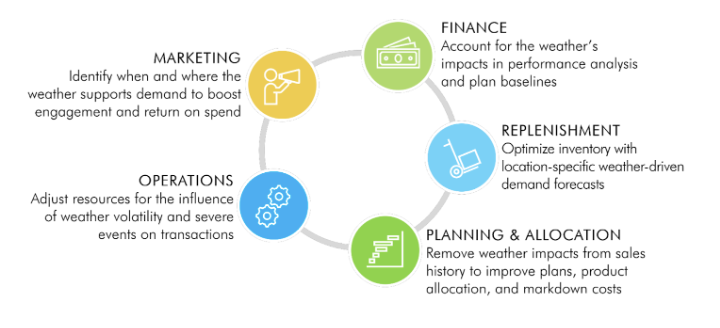
Image via National Retail Federation
Map Geographic Vulnerability: Utilizing tools like ClimRR or Resource Watch to visualize future exposure to extreme climate events like heat, flooding, wildfires, or sea level rise can inform locations, staffing, and supply chain decisions.
Rethink Location Strategy: As coverage options shrink and premiums rise, re-evaluate store locations viability and explore risk-sharing strategies.
Integrate Climate Across Teams: Climate strategy should no longer sit solely within sustainability. From procurement to merchandising, resilience planning needs to show up in all departments and decisions.
Proactive, Not Reactive
92% of business leaders view extreme weather as the new normal, with most expecting a climate-related event to impact their organization this year (KPMG). The question is no longer if extreme weather will affect your operations, it’s whether or not you’ll be prepared when it does. A nuanced understanding of weather-based risks (planetary, economic, financial market) can support a comprehensive risk management approach, ensuring resilience against the multifaceted challenges posed by extreme weather events (Columbia Center on Sustainable Investment).
With Q4 retail planning well underway and 2026 planning on the horizon, now is the moment to integrate extreme weather into demand planning, inventory management, and insurance review. It’s also a window to build resilience before volatility strikes. Retailers that invest now in forecasting, resilience, and climate-informed strategy will have a competitive edge in the years ahead.